Before the opening scene
The Plane Crash
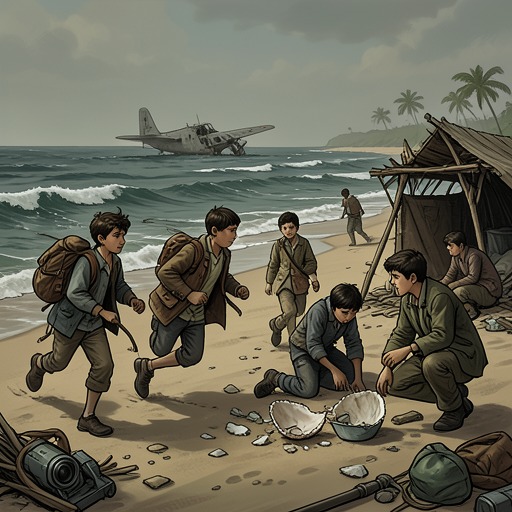
A wartime evacuation flight carrying schoolboys is attacked and breaks apart over the ocean. The scattered wreckage leaves the boys stranded on an unfamiliar tropical island, with no adults immediately present to take charge.
The first morning
Ralph Meets Piggy
[Ralph](entity:character-recall-character-ralph-5eacffcc40e0) makes his way through the jungle scar left by the crash and meets [Piggy](entity:character-recall-character-piggy-008657f9ae84), a bespectacled boy who is anxious about the missing adults and the other survivors. Piggy explains that the plane was damaged and may have gone down at sea.
The first morning
The Island Revealed
[Ralph](entity:character-recall-character-ralph-5eacffcc40e0) reaches the shore and delights in the lagoon, palms, warm water, and apparent freedom from adult supervision. [Piggy](entity:character-recall-character-piggy-008657f9ae84), more troubled by their isolation, recognizes that rescue is uncertain and that nobody may know where they landed.
The first morning
The Shell in the Lagoon
[Ralph](entity:character-recall-character-ralph-5eacffcc40e0) spots a large pale shell in the lagoon. With [Piggy](entity:character-recall-character-piggy-008657f9ae84)'s help, he retrieves it, and Piggy identifies it as a conch that can be blown to summon the scattered boys.
The first morning
The Conch’s First Call
After struggling to make a sound, [Ralph](entity:character-recall-character-ralph-5eacffcc40e0) blows [The conch](entity:object-recall-object-the-conch-5c4661668259) with a forceful breath. Its deep note carries across [The island](entity:location-recall-location-the-island-51ec41aeb699), drawing boys out of the forest and along the beach toward the platform.
The first morning
The Survivors Gather
Boys of different ages arrive in small groups, including the youngest boys and the twins [Sam and Eric](entity:character-recall-character-sam-and-eric-c3f77ed5d9cf). [Piggy](entity:character-recall-character-piggy-008657f9ae84) tries to record names, while [Ralph](entity:character-recall-character-ralph-5eacffcc40e0)'s call gives the gathering a sense that someone has begun to organize their new circumstances.
The first morning
The Choir Arrives
[Jack Merridew](entity:character-recall-character-jack-merridew-a2b9beb8e3a2) leads a line of choirboys to the assembly, dressed in their dark uniforms despite the heat. His confidence and command of the group immediately distinguish him as a potential rival for authority.
The first morning
Ralph Is Elected Chief
[Ralph](entity:character-recall-character-ralph-5eacffcc40e0) proposes choosing a chief, and the boys vote. Most of the group supports him, drawn by his calm presence and his association with [The conch](entity:object-recall-object-the-conch-5c4661668259), while the choir alone votes for [Jack Merridew](entity:character-recall-character-jack-merridew-a2b9beb8e3a2).
The first morning
Jack Receives the Hunters
To soften the disappointment of losing the election, [Ralph](entity:character-recall-character-ralph-5eacffcc40e0) gives [Jack Merridew](entity:character-recall-character-jack-merridew-a2b9beb8e3a2) authority over the choir. Jack chooses to make them hunters, establishing a role that offers him a separate source of status and influence.
The first morning
Piggy Is Left Behind
[Ralph](entity:character-recall-character-ralph-5eacffcc40e0), [Jack Merridew](entity:character-recall-character-jack-merridew-a2b9beb8e3a2), and [Simon](entity:character-recall-character-simon-99ba1396ec7a) prepare to explore, while [Piggy](entity:character-recall-character-piggy-008657f9ae84) asks to join them. The older boys dismiss him as unfit for the expedition, and Ralph's earlier disclosure of Piggy's unwanted nickname leaves him humiliated and excluded.
The first afternoon
The First Island Expedition
[Ralph](entity:character-recall-character-ralph-5eacffcc40e0), [Jack Merridew](entity:character-recall-character-jack-merridew-a2b9beb8e3a2), and [Simon](entity:character-recall-character-simon-99ba1396ec7a) cross rough ground and climb through dense forest toward the island's heights. The difficult journey feels exhilarating to them: for a time, their hardship becomes part of a shared adventure rather than a reminder of danger.
The first afternoon
The Island Confirmed
From the mountain, the three boys see a horizon of water all around them and understand that they are on an island. They find no sign of a settlement or passing ship, though [Ralph](entity:character-recall-character-ralph-5eacffcc40e0) remains hopeful that rescue will come.
The first afternoon
The Rock Falls
On their descent, the boys discover they can shove a massive rock from its precarious position. It crashes through the forest, giving them a first taste of power over the landscape and of destructive play.
The first afternoon
Jack’s First Failure
The explorers come upon a piglet trapped in creepers. [Jack Merridew](entity:character-recall-character-jack-merridew-a2b9beb8e3a2) raises his knife but hesitates at the thought of cutting into living flesh, and the animal escapes before he can strike.
The first evening
The Rules of Assembly
[Ralph](entity:character-recall-character-ralph-5eacffcc40e0) explains that the boys need rules and proposes that whoever holds [The conch](entity:object-recall-object-the-conch-5c4661668259) has the right to speak without interruption. The arrangement gives their meetings a formal structure and makes the shell an emblem of shared authority.
The first evening
A Boy Reports a Beast
A small boy with a birthmark says he saw a huge, snake-like creature in the forest at night. [Ralph](entity:character-recall-character-ralph-5eacffcc40e0) dismisses the story as a nightmare, but the youngest boys remain uneasy, and fear becomes an issue the group cannot simply vote away.
The first evening
The Rescue Fire Proposed
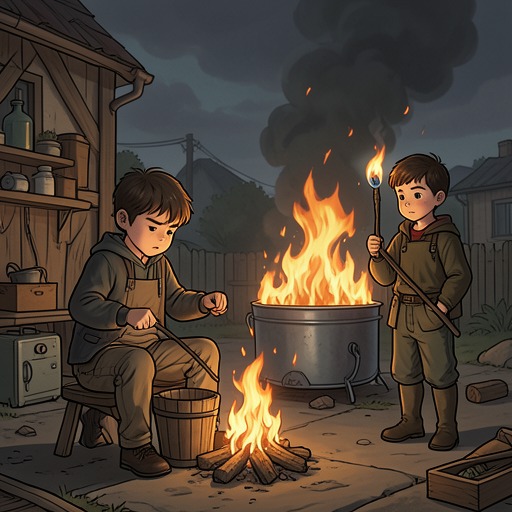
[Ralph](entity:character-recall-character-ralph-5eacffcc40e0) tells the assembly that a passing ship may not notice them unless they create smoke. He urges the boys to build a signal fire on the mountain, making rescue a shared responsibility and a test of their new community.
The first evening
Piggy’s Glasses Light the Fire
The boys discover that sunlight focused through [Piggy’s spectacles](entity:object-recall-object-piggy-323537d4445a) can ignite dry wood. [Jack Merridew](entity:character-recall-character-jack-merridew-a2b9beb8e3a2) takes the glasses from [Piggy](entity:character-recall-character-piggy-008657f9ae84) to start the blaze, revealing how useful Piggy is while also showing how easily his needs and consent are ignored.
The first evening
The First Forest Fire
The boys pile on more dry wood than they can control, and the flames spread from the mountain into the forest. Their excitement fades as the fire becomes a destructive force, while [Piggy](entity:character-recall-character-piggy-008657f9ae84) warns that the youngest boy who reported the beast cannot be found.
The first evening
The Birthmarked Boy Disappears
As the forest burns, [Piggy](entity:character-recall-character-piggy-008657f9ae84) realizes that the boy with the birthmark may have been among the children caught near the blaze. No one can locate him, and the meeting's silence turns the cost of their heedless excitement into a lasting, unresolved loss.
After the first day
Huts Remain Unfinished
[Ralph](entity:character-recall-character-ralph-5eacffcc40e0) and [Simon](entity:character-recall-character-simon-99ba1396ec7a) labor to build shelters, but most of the boys drift away to play, swim, or hunt. The structures remain flimsy, and Ralph grows frustrated that decisions made at meetings do not reliably turn into work.
After the first day
Simon Helps the Littluns
[Simon](entity:character-recall-character-simon-99ba1396ec7a) finds fruit the youngest boys cannot reach and passes it down to them. His quiet generosity contrasts with the older boys' self-interest, and he later retreats alone to a secluded clearing in the forest.
The first days
Jack Becomes Absorbed in Hunting
[Jack Merridew](entity:character-recall-character-jack-merridew-a2b9beb8e3a2) searches the forest for pig tracks, increasingly driven by the desire to make a kill. When he returns without meat, tension grows between his hunting ambitions and [Ralph](entity:character-recall-character-ralph-5eacffcc40e0)'s insistence on shelters and rescue preparations.
The first days
Roger Tests the Old Limits
[Roger](entity:character-recall-character-roger-4904421e469b) follows [Henry](entity:character-recall-character-henry-c166031952d6) along the shore and throws stones around him, carefully missing. The remaining restraint is not kindness so much as the lingering force of rules and authority from the boys' former lives.
The first days
Jack Paints His Face
[Jack Merridew](entity:character-recall-character-jack-merridew-a2b9beb8e3a2) smears clay and charcoal across his face as camouflage for hunting. Seeing himself transformed, he feels released from self-consciousness, and the mask helps make violence seem easier to carry out.
Several days after the crash
The Fire Watch Fails
While [Ralph](entity:character-recall-character-ralph-5eacffcc40e0) watches the horizon, a ship appears in the distance. [The signal fire](entity:object-recall-object-the-signal-fire-4f9dfe41c993) on the mountain has gone out because the hunters left their watch to pursue a pig, and the chance of rescue passes without the boys being seen.
Several days after the crash
The First Pig Is Killed
[Jack Merridew](entity:character-recall-character-jack-merridew-a2b9beb8e3a2) and his hunters return carrying a dead pig and celebrating the kill. Their excitement over meat and hunting clashes with [Ralph](entity:character-recall-character-ralph-5eacffcc40e0)'s anger that they abandoned the signal fire when a ship was in sight.
After the first successful hunt
The Meat Divides the Boys
The hunters roast and share the pig, but [Jack Merridew](entity:character-recall-character-jack-merridew-a2b9beb8e3a2) initially withholds meat from [Piggy](entity:character-recall-character-piggy-008657f9ae84) because he did not hunt. [Simon](entity:character-recall-character-simon-99ba1396ec7a) gives Piggy part of his own portion, while the others join a reenactment of the kill that foreshadows more dangerous group rituals.
After the missed ship
Ralph Calls a Serious Meeting
[Ralph](entity:character-recall-character-ralph-5eacffcc40e0) calls an assembly to address the failure to maintain the fire, the unfinished shelters, and the boys' neglect of basic arrangements. He insists that meetings must lead to action rather than becoming occasions for noise and amusement.
During the serious assembly
Ralph Reinforces the Fire Rule
[Ralph](entity:character-recall-character-ralph-5eacffcc40e0) declares that the signal fire is more important than hunting and sets rules for sanitation and the use of fires. The boys assent, but their weak commitment and [Jack Merridew](entity:character-recall-character-jack-merridew-a2b9beb8e3a2)'s competing priorities make the rules difficult to enforce.
During the serious assembly
The Beast Returns to Debate
When the assembly turns to fear, [Jack Merridew](entity:character-recall-character-jack-merridew-a2b9beb8e3a2) claims that he has searched the island and found no beast. [Piggy](entity:character-recall-character-piggy-008657f9ae84) argues that fear is not an animal, while [Simon](entity:character-recall-character-simon-99ba1396ec7a) hesitantly suggests that perhaps the feared thing is within the boys themselves.
That night
The Assembly Descends into Disorder
A littlun describes seeing something moving near the shelters, and the possibility of a beast from the sea sparks an argument. When a vote on ghosts exposes the boys' uncertainty, [Jack Merridew](entity:character-recall-character-jack-merridew-a2b9beb8e3a2) rejects the rules, breaks from the meeting, and leads the others in a frenzied dance.
That night
The Parachutist Arrives
During an aerial battle, a dead parachutist drifts down and catches among the rocks on the mountain. The wind tugs at the parachute and moves the body, making it appear to sit up and bow in the darkness.
Before dawn
The Twins See the Beast
[Sam and Eric](entity:character-recall-character-sam-and-eric-c3f77ed5d9cf), tending the fire, see the parachutist's body move in the wind and mistake it for a furry creature with wings. They flee in terror and report their sighting to [Ralph](entity:character-recall-character-ralph-5eacffcc40e0) and the assembly, giving the boys' fears an apparent physical confirmation.
The morning after the sighting
The Hunt for the Beast Begins
[Ralph](entity:character-recall-character-ralph-5eacffcc40e0) organizes an expedition to search for the beast, while [Piggy](entity:character-recall-character-piggy-008657f9ae84) stays behind with the youngest boys. Although Ralph questions the account, he recognizes that the group cannot remain paralyzed by fear or abandon its need for food and rescue.
During the search
Ralph Wounds a Boar
A boar charges along a pig track, and [Ralph](entity:character-recall-character-ralph-5eacffcc40e0) throws his spear, striking its snout. The brief success thrills him and wins the hunters' attention, but [Jack Merridew](entity:character-recall-character-jack-merridew-a2b9beb8e3a2)'s focus quickly returns to the hunt and the imagined beast.
During the search
The Boys Circle Robert
The boys turn their excitement into a mock hunt, surrounding [Robert](entity:character-recall-character-robert-dcc9e88f1178) and jabbing at him as if he were a pig. The game becomes frighteningly physical before they stop, revealing how readily the hunting ritual can turn a companion into a target.
Later that day
The Castle Rock Search
The boys reach [Castle Rock](entity:location-recall-location-castle-rock-01d0b06559db), a steep coastal outcrop that could serve as a fort. [Ralph](entity:character-recall-character-ralph-5eacffcc40e0) and [Jack Merridew](entity:character-recall-character-jack-merridew-a2b9beb8e3a2) inspect it for signs of the beast, but find no creature, only a difficult landscape and opportunities for more rough play.
That night
The Nighttime Mountain Expedition
With daylight gone, [Ralph](entity:character-recall-character-ralph-5eacffcc40e0), [Jack Merridew](entity:character-recall-character-jack-merridew-a2b9beb8e3a2), and [Roger](entity:character-recall-character-roger-4904421e469b) climb toward the mountain to investigate the reported beast. Ralph and Jack Merridew challenge each other's courage, while Roger follows them into the dark and smoky terrain.
That night
The Parachutist Mistaken for a Beast
Near the summit, the boys glimpse the parachutist's body in the wind-blown darkness and believe they have found a huge creature. They panic and flee, leaving the harmless corpse to deepen the terror that is already dividing them.
The following morning
Jack Challenges Ralph’s Leadership
Back at the assembly, [Jack Merridew](entity:character-recall-character-jack-merridew-a2b9beb8e3a2) accuses [Ralph](entity:character-recall-character-ralph-5eacffcc40e0) of cowardice and proposes that the boys remove him as chief. No one raises a hand against Ralph, and Jack, humiliated by the silence, declares that he will leave and hunt independently.
After the failed challenge
Jack Forms a Rival Tribe
[Jack Merridew](entity:character-recall-character-jack-merridew-a2b9beb8e3a2) leads his followers away from [Ralph](entity:character-recall-character-ralph-5eacffcc40e0)'s group and establishes his own tribe near the far end of the island. He promises hunting, meat, and freedom from the old assemblies, building authority around the immediate rewards of belonging and violence.
After Jack's departure
The Signal Fire Moves to the Beach
[Ralph](entity:character-recall-character-ralph-5eacffcc40e0)'s remaining group decides to build a smaller fire near the beach rather than return to the mountain, where they fear the beast may be. [Piggy](entity:character-recall-character-piggy-008657f9ae84) helps light it with his spectacles, but the new location makes the signal harder to see from far away.
The same day
Jack Recruits with a Feast
[Jack Merridew](entity:character-recall-character-jack-merridew-a2b9beb8e3a2) addresses his followers and says they will forget the beast, hunt, and feast. He also proposes leaving part of a kill as an offering, transforming fear into a practice that reinforces his authority over the tribe.
The following afternoon
The Sow Is Hunted
[Jack Merridew](entity:character-recall-character-jack-merridew-a2b9beb8e3a2)'s hunters find a sow nursing her piglets and drive spears into her as she tries to escape. The chase grows more frenzied as the wounded animal bleeds through the forest, until the hunters surround and kill her in a clearing.
Immediately after the sow’s death
The Pig’s Head Is Offered
[Jack Merridew](entity:character-recall-character-jack-merridew-a2b9beb8e3a2) orders a sharpened stick driven through the sow's head and declares it a gift for the beast. The hunters leave the grisly offering in the clearing, where flies gather and the severed head becomes an emblem of the violence they have embraced.
That afternoon
Simon Faces the Lord of the Flies
Alone in the clearing, [Simon](entity:character-recall-character-simon-99ba1396ec7a) stares at the pig's head as exhaustion and heat distort his perceptions. In a hallucinated exchange, the Lord of the Flies tells him that the beast is not an animal to be hunted but a darkness within the boys themselves.
That evening
Jack Raids for Fire
[Jack Merridew](entity:character-recall-character-jack-merridew-a2b9beb8e3a2) and painted hunters rush [Ralph](entity:character-recall-character-ralph-5eacffcc40e0)'s camp and seize burning branches from the fire. Rather than openly attack the whole group, Jack Merridew announces his tribe's feast and invites the others, using stolen fire and food to draw boys toward his side.
That evening
Simon Frees the Parachutist
After recovering from his collapse, [Simon](entity:character-recall-character-simon-99ba1396ec7a) climbs the mountain and discovers that the supposed beast is a dead parachutist tangled in his lines. He frees the body from the rocks and sets off toward the beach, hoping to tell the other boys the truth.
That evening
Jack’s Feast Begins
[Ralph](entity:character-recall-character-ralph-5eacffcc40e0) and [Piggy](entity:character-recall-character-piggy-008657f9ae84) approach Jack's camp and find the boys gathered around roasted meat. Jack sits as a chief before his followers, offering food and protection from the beast as inducements to join his tribe.
During the storm that evening
The Dance Turns on Simon
As thunder and lightning intensify the boys' fear, [Jack Merridew](entity:character-recall-character-jack-merridew-a2b9beb8e3a2) leads a ritualized dance around a circle. [Simon](entity:character-recall-character-simon-99ba1396ec7a) emerges from the forest trying to tell them the beast is a dead man, but the frenzied crowd mistakes him for the creature and beats him to death.
After the storm
Simon’s Body Is Carried Seaward
The rain subsides, and the tide rises around [Simon](entity:character-recall-character-simon-99ba1396ec7a)'s body on the beach. Phosphorescent sea creatures gather around him as the water lifts and carries his body out toward the open sea, giving his death a quiet, mournful passage.
The following morning
Ralph Names the Murder
[Ralph](entity:character-recall-character-ralph-5eacffcc40e0) tells [Piggy](entity:character-recall-character-piggy-008657f9ae84) that [Simon](entity:character-recall-character-simon-99ba1396ec7a)'s death was murder, but Piggy insists that the storm, darkness, and terror made the killing an accident. Both recognize that they took part in the dance, and Piggy urges them to deny their involvement to [Sam and Eric](entity:character-recall-character-sam-and-eric-c3f77ed5d9cf).
That morning
The Twins Deny the Dance
When [Sam and Eric](entity:character-recall-character-sam-and-eric-c3f77ed5d9cf) return, the boys offer strained explanations about leaving the feast early and becoming lost. Their shared denials show how the group is already trying to bury its responsibility for [Simon](entity:character-recall-character-simon-99ba1396ec7a)'s death.
After Simon’s death
The Tribe Takes Castle Rock
Jack's followers occupy [Castle Rock](entity:location-recall-location-castle-rock-01d0b06559db) and fortify its narrow entrance with a heavy boulder. [Roger](entity:character-recall-character-roger-4904421e469b)'s growing willingness to use power without explanation is evident when he learns that [Jack Merridew](entity:character-recall-character-jack-merridew-a2b9beb8e3a2) has ordered Wilfred beaten without giving a reason.
That night
A Night Raid for Piggy’s Glasses
[Jack Merridew](entity:character-recall-character-jack-merridew-a2b9beb8e3a2)'s hunters attack [Ralph](entity:character-recall-character-ralph-5eacffcc40e0)'s shelter in darkness, leaving the boys bruised and confused. They do not take [The conch](entity:object-recall-object-the-conch-5c4661668259); instead they steal [Piggy](entity:character-recall-character-piggy-008657f9ae84)'s spectacles, depriving him of sight and taking the group's only reliable way to light a fire.
The next dawn
The Survivors Convene
At the cold remains of their fire, [Ralph](entity:character-recall-character-ralph-5eacffcc40e0), [Piggy](entity:character-recall-character-piggy-008657f9ae84), and [Sam and Eric](entity:character-recall-character-sam-and-eric-c3f77ed5d9cf) discuss the raid. Piggy insists on going to [Castle Rock](entity:location-recall-location-castle-rock-01d0b06559db) to demand his spectacles, believing that an appeal to fairness may still reach [Jack Merridew](entity:character-recall-character-jack-merridew-a2b9beb8e3a2)'s tribe.
That morning
The March to Castle Rock
[Ralph](entity:character-recall-character-ralph-5eacffcc40e0)'s small group walks along the beach toward [Castle Rock](entity:location-recall-location-castle-rock-01d0b06559db), carrying [The conch](entity:object-recall-object-the-conch-5c4661668259) as a reminder of the rules they once shared. [Piggy](entity:character-recall-character-piggy-008657f9ae84), nearly blind without his glasses, is led between the others and insists on making his case himself.
That morning
Ralph Demands the Spectacles
At the entrance to [Castle Rock](entity:location-recall-location-castle-rock-01d0b06559db), [Jack Merridew](entity:character-recall-character-jack-merridew-a2b9beb8e3a2)'s painted guards challenge [Ralph](entity:character-recall-character-ralph-5eacffcc40e0) and refuse to let the group pass. Ralph blows [The conch](entity:object-recall-object-the-conch-5c4661668259) and demands the return of [Piggy](entity:character-recall-character-piggy-008657f9ae84)'s spectacles, while the tribe's laughter makes clear how little authority the old symbol now commands.
During the confrontation
Ralph and Jack Clash
[Jack Merridew](entity:character-recall-character-jack-merridew-a2b9beb8e3a2) arrives and orders [Ralph](entity:character-recall-character-ralph-5eacffcc40e0) to leave his territory. Ralph insists that the glasses must be returned and that the fire should be shared; the two boys attack one another with their spears, stopping short of using the sharpened points lethally.
During the confrontation
Piggy Appeals to the Tribe
[Piggy](entity:character-recall-character-piggy-008657f9ae84) stands with [The conch](entity:object-recall-object-the-conch-5c4661668259) and argues that rules and rescue matter more than hunting and killing. The tribe jeers at him, while [Roger](entity:character-recall-character-roger-4904421e469b) watches from above and begins to exert a power no longer restrained by the old prohibitions.
That morning
Piggy and the Conch Are Destroyed
[Roger](entity:character-recall-character-roger-4904421e469b) releases the great boulder from above. It strikes [Piggy](entity:character-recall-character-piggy-008657f9ae84) and knocks him from the ledge to the rocks below, killing him; at the same moment, [The conch](entity:object-recall-object-the-conch-5c4661668259) shatters into fragments, extinguishing the final visible sign of the boys' former order.
Immediately after Piggy’s death
The Twins Are Captured
[Jack Merridew](entity:character-recall-character-jack-merridew-a2b9beb8e3a2) declares himself chief and drives the remaining boys back toward the tribe. [Sam and Eric](entity:character-recall-character-sam-and-eric-c3f77ed5d9cf) are seized and pressured to join, while [Ralph](entity:character-recall-character-ralph-5eacffcc40e0) escapes alone into the forest, wounded and hunted.
That afternoon
Ralph Hides from the Tribe
[Ralph](entity:character-recall-character-ralph-5eacffcc40e0) moves through the forest, hungry and injured, and sees the tribe guarding [Castle Rock](entity:location-recall-location-castle-rock-01d0b06559db). He briefly approaches the clearing where the pig's head had been offered, smashes its skull, and takes the remaining stick as a weapon.
That night
The Twins Reveal the Plan
[Ralph](entity:character-recall-character-ralph-5eacffcc40e0) creeps up to [Sam and Eric](entity:character-recall-character-sam-and-eric-c3f77ed5d9cf), who are guarding [Castle Rock](entity:location-recall-location-castle-rock-01d0b06559db). They warn him that [Jack Merridew](entity:character-recall-character-jack-merridew-a2b9beb8e3a2)'s tribe will hunt him across the island and that [Roger](entity:character-recall-character-roger-4904421e469b) has sharpened a stick at both ends, a threat whose purpose Ralph cannot bear to understand.
The following morning
The Searchers Begin Their Hunt
At first light, the tribe spreads across the island in a line, using cries to coordinate the search for [Ralph](entity:character-recall-character-ralph-5eacffcc40e0). Ralph hides in a dense thicket, relying on its tangled growth to make him difficult to reach.
During the hunt
Ralph Fights Back
When the hunters discover [Ralph](entity:character-recall-character-ralph-5eacffcc40e0)'s hiding place, they try to drive him out by rolling boulders into the thicket. Ralph thrusts his spear through the branches and wounds one of the searchers, but the attack forces him to abandon his shelter.
During the hunt
The Island Is Set Ablaze
Unable to reach [Ralph](entity:character-recall-character-ralph-5eacffcc40e0) in the thicket, the tribe sets the forest on fire to smoke him out. The flames spread through the vegetation and toward the beach, destroying cover but also producing a vast plume of smoke visible from the sea.
Near the ending
Ralph Breaks from the Line
As the fire approaches, [Ralph](entity:character-recall-character-ralph-5eacffcc40e0) repeatedly weighs hiding against trying to break through the hunters' cordon. When a searcher peers into his thicket, Ralph bursts out screaming, strikes him with his stick, and runs toward the beach with the tribe in pursuit.
The ending
The Naval Officer Arrives
[Ralph](entity:character-recall-character-ralph-5eacffcc40e0) reaches the beach and collapses before a naval officer who has come ashore after seeing the smoke. The officer's arrival interrupts the chase, and the painted boys fall silent as the adult world they imagined returns in the form of a warship.
The ending
The Boys Are Rescued
The officer asks whether any adults are with the boys and learns that two have died. [Ralph](entity:character-recall-character-ralph-5eacffcc40e0) identifies himself as chief, while the others gather behind him, marked by paint, dirt, and the collapse of their community.
The ending
Ralph Weeps for the Lost
As the officer looks away to give the boys privacy, [Ralph](entity:character-recall-character-ralph-5eacffcc40e0) breaks down in grief. He weeps for the end of innocence, the darkness within human beings, and [Piggy](entity:character-recall-character-piggy-008657f9ae84), whose clear thought and loyal friendship could not survive the island's violence.